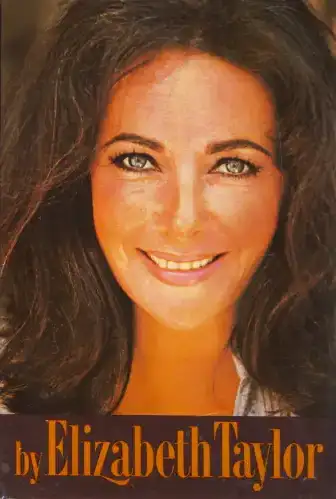
Elizabeth Taylor: An Informal Memoir
“ELIZABETH TAYLOR speaks in her autobiography as if she were talking to a close friend. With total candor and great insight, she reviews her early family years, her controversial career as a world-famous actress, the men in her stormy private life, her delightful and beautiful children, and her happiness as the wife of Richard Burton.
“Elizabeth Taylor’s dreams, hopes, and desires as a woman have been shared by millions throughout the world. But only one person could tell this story of angers and aspirations, deep sorrows and great happiness—Elizabeth Taylor herself.” [From the paperback edition]
Publisher Harper & Row paid Elizabeth $250,000 for Elizabeth Taylor: An Informal Memoir, a brief account of her life so far that was published in 1965. The book was based on forty hours of intimate tape-recorded conversations between Elizabeth and writer and journalist Richard Merryman. (In the book, she thanks Merryman “for his help and his tape recorder.” These intimate conversations would also later form the basis of the acclaimed 2024 documentary, Elizabeth Taylor: The Lost Tapes.)
“This book is probably best described not as an autobiography—that’s much too pretentious—but as a long, slightly overcozy conversation with a garrulous broad named Betty Burton,” Elizabeth explains. “I have no doubt that a lot of it will seem rather like a bad novelette. I’m afraid much of my life has been a cliche—except that at the time the feelings were tremendously deep.”
Elizabeth admits in the opening sentence of An Informal Memoir that she has “very mixed feelings about this book.” She goes on to say that “there is a point of privacy beyond which I simply will not go, because it would involve throwing mud.” She is understandably reticent about delving too deep into certain episodes and relationships (the final book, for example, omits the revelation she made to Merryman of Eddie Fisher “standing over her with a gun”).

She dedicates An Informal Memoir to “the lady from Pismo Beach,” her moniker for the individual “who reads that made-up stuff [about her] and believes it, wants to believe it and is going to believe it regardless of what she reads.” Elizabeth adds: “I’m not even too sure what image the lady from Pismo Beach has of me—except probably she thinks I’m rather scandalous, unstable, a wicked witch with very little feeling—ruthless, fairly lame-brained, determined. Somebody who snaps a finger and gets what she wants.”
“Everything that I have done in my life that is a mistake I will admit is a mistake and answer for it,” she says towards the end of the book. “But I am not going to answer for an image created by hundreds of people who do not know what’s true or false. That would take me from here to doomsday.”
An Informal Memoir features fifty-six photographs from Elizabeth’s family album and by her dear friend Roddy McDowall, who was not only an incredibly talented actor, but also an accomplished photographer. “There have, of course, been pictures of myself that I think are okay,” Elizabeth explains. “But I was either unaware of the camera or the photographer was somebody like Roddy McDowall or Dick Avedon, both of whom I trust completely. I’m just no good trying to relax for photographers I don’t know well.”
Excerpts from An Informal Memoir appeared in the December 18, 1964 issue of Life magazine, ahead of its publication the following year.